
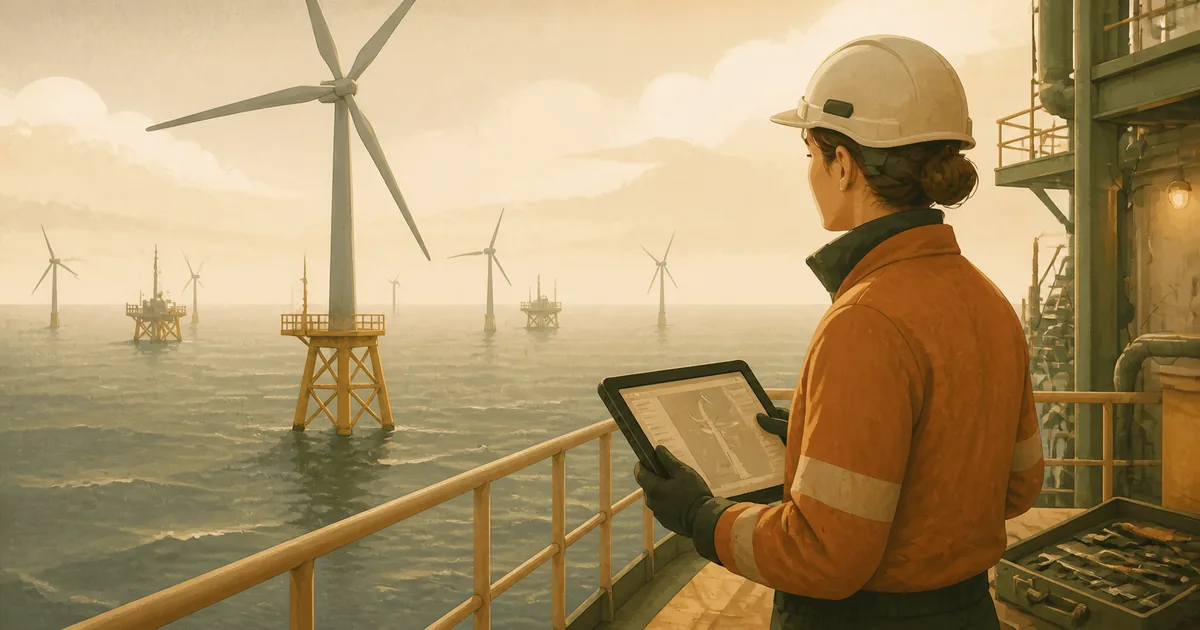
The Danish energy sector is developing rapidly, driven by ambitious climate goals and global demand for sustainable energy. At the heart of this transformation, offshore engineers stand as key figures who design, implement, and maintain the complex installations that harvest energy from the sea. From the enormous wind farms in the North Sea to the still-relevant oil and gas platforms and future Power-to-X facilities, the need for sharp engineering minds is greater than ever.
Imagine standing on the deck of an installation vessel while a giant wind turbine blade is hoisted into place, or monitoring complex systems deep beneath the ocean surface from a control room. This is everyday life for many offshore engineers – a job that combines theoretical knowledge with practical problem-solving in a unique and often demanding environment. If you dream of a career with meaning, technological innovation, and excellent future prospects, read on.
What does an offshore engineer actually do?
An offshore engineer works with the design, construction, installation, operation, and maintenance of structures and systems in the marine environment. Their expertise is essential for utilizing the ocean's resources, whether it involves energy extraction or other maritime operations.
From seabed to horizon: The tasks span widely
The workday for an offshore engineer is rarely monotonous. Tasks can include:
- Design and analysis: Developing concepts, detailed design of foundations, platforms, pipelines, cables, and equipment using advanced software like CAD and FEA.
- Project management: Planning, coordinating, and managing complex offshore projects from start to finish.
- Installation and commissioning: Monitoring and leading installation processes at sea, ensuring correct assembly and testing of systems.
- Operations and maintenance: Developing maintenance strategies, inspecting equipment (often using drones or ROVs), troubleshooting and repairs.
- Safety and environment: Developing and implementing safety procedures, environmental assessments, and ensuring compliance with regulatory requirements.
- Research and development: Working with innovation and development of new technologies for floating wind turbines, wave energy, or CO2 storage.
Typical industries: Wind, oil/gas and new technologies
Denmark is a global leader in offshore wind, and this sector employs a large number of offshore engineers. Companies like Ørsted, Vestas, and Siemens Gamesa are central players. But offshore engineers also find employment in:
- Oil and gas: Operation, maintenance, and gradual decommissioning of existing installations in the North Sea.
- Power-to-X (PtX): Production of green fuels (hydrogen, ammonia, methanol) using power from offshore wind turbines.
- CO2 storage (CCS): Storage of captured CO2 in depleted oil and gas fields beneath the seabed.
- Cable and pipeline installation: Establishing cable networks and pipelines for hydrogen or CO2.
- Maritime operations and specialized vessels: Design and operation of specialized vessels.
The competency map: What does it take to become an offshore engineer?
Working as an offshore engineer requires a solid professional background combined with a range of personal qualities.
The technical toolbox: Essential skills
The foundation is typically an engineering degree at bachelor's or master's level in relevant fields such as mechanical engineering, civil engineering, electrical engineering, energy technology, or marine engineering. Specific technical skills include:
- Strong theoretical understanding: Mechanics, fluid mechanics, thermodynamics, materials science, structural analysis, electrical engineering.
- Software competencies: Experience with CAD tools (AutoCAD, SolidWorks), FEA software (ANSYS, Abaqus), and programming languages (Python, MATLAB).
- Process understanding: Knowledge of production processes, installation techniques, and maintenance strategies.
- Standards and regulations: Understanding of international standards (DNV, ISO, NORSOK) and relevant legislation.
Soft skills: Collaboration and problem-solving under pressure
- Problem-solving: The ability to analyze complex problems and find innovative solutions under time pressure.
- Communication: Clear communication skills, often in English, as teams are typically international.
- Collaboration skills: The ability to work effectively in interdisciplinary teams with colleagues from different cultures.
- Adaptability and resilience: Offshore work can involve changing working conditions and long periods away from home.
- Decision-making: The ability to make well-founded decisions, sometimes with limited information.
Safety first: Mandatory courses and certifications
Safety is paramount in the offshore industry. Before you can set foot on an offshore installation, mandatory safety courses are required:
- BOSIET/FOET: Basic offshore safety course covering helicopter flight and evacuation, first aid, firefighting, and sea survival.
- GWO Basic Safety Training: Specific to the wind turbine industry.
- Specialized courses: Depending on job function, additional courses may be necessary.
The path to an offshore career: Education and further training
Relevant engineering programs in Denmark
- Technical University of Denmark (DTU): Offers a wide range of engineering programs, including specialized master's programs such as "Offshore Wind Energy" or "Maritime Engineering".
- Aalborg University (AAU): Known for its problem-based learning with strong programs in energy, construction, and mechanical engineering. AAU in Esbjerg has a particular focus on offshore energy.
- University of Southern Denmark (SDU): Offers relevant engineering programs focusing on energy and maritime technologies.
- Aarhus University (AU): Has engineering programs in mechanical and electrical engineering.
Specialization and continuing education
Technology in the offshore sector is constantly evolving. Lifelong learning is essential:
- Specialized courses in new technologies, software tools, or project management methods
- Master's degrees or diploma programs
- Certifications in project management (PMP, PRINCE2)
- Conferences and seminars organized by organizations like IDA (The Danish Society of Engineers)
The salary package: What can you expect to earn offshore?
One of the major attractions of an offshore career is undoubtedly the salary. The work is demanding and often involves periods away from home, which is typically reflected in an attractive compensation package.
Factors affecting salary
- Experience: New graduates start at a lower level than experienced specialists.
- Education level and specialization: A master's degree or sought-after specialization can provide a boost.
- Responsibility and position: A project manager will typically earn more than an engineer without personnel responsibility.
- Company size: Large international energy companies can often offer higher salaries.
- Rotation and offshore allowance: Working offshore typically triggers a significant allowance.
Salary levels: From new graduate to experienced specialist
Based on industry sources, these generalized examples of monthly salary including fixed allowances (excluding variable bonuses and pension) can be outlined:
- New graduate offshore engineer (0-2 years experience): DKK 50,000 – 70,000 before tax
- Offshore engineer with experience (3-10 years experience): DKK 70,000 – 100,000 before tax
- Senior/Lead offshore engineer or specialist (10+ years experience): DKK 90,000 – 130,000+ before tax
Life offshore: Challenges, rewards, and work environment
Working offshore is not a typical 9-to-5 job. It's a lifestyle that offers unique challenges and rewards.
Rotations and working hours
Most offshore jobs involve a rotation arrangement, typically:
- 2 weeks on, 2 weeks off
- 2 weeks on, 3 weeks off
- 2 weeks on, 4 weeks off (more common in the North Sea)
When offshore, you typically work 12-hour shifts, 7 days a week, for the entire period. This means intensive work periods, but in return, you have long, continuous periods off at home.
Safety and work environment in focus
The safety culture offshore is extremely high. There are constant drills, safety briefings, and a strong focus on preventing accidents. Facilities are often of high standard with comfortable cabins, fitness rooms, internet access, and good catering.
The unique benefits of an offshore job
- High salary and good allowances
- Long periods off: Provides opportunity to pursue hobbies, travel, or have quality time with family
- Strong camaraderie: Close collaboration often creates strong bonds
- Professional development: Work with advanced technology and complex projects
- International environment: Opportunity to work with people from around the world
- Meaningful work: Especially in renewable energy, you contribute directly to the green transition
The future for offshore engineers in Denmark: Green transition and new horizons
The future outlook for offshore engineers in Denmark is particularly positive, primarily driven by the green transition.
The green wave: Continued growth in wind energy
Denmark has committed to ambitious expansion targets for offshore wind. Plans for energy islands, new large offshore wind farms, and repowering of older farms will create sustained demand for engineering competencies for many years to come.
New technologies: Power-to-X and CO2 storage
- Power-to-X (PtX): Technologies that convert green electricity to hydrogen, ammonia, or methanol are seen as crucial for decarbonizing heavy transport and industry.
- CO2 storage (CCS): To meet climate targets, it may be necessary to capture CO2 and store it permanently in the North Sea.
How to land your dream job offshore: Tips and resources
Where to find positions
- Company websites: Ørsted, Vestas, Siemens Gamesa, TotalEnergies, Equinor, Semco Maritime, Cadeler, Maersk Supply Service, and more.
- Job portals: LinkedIn, Jobindex, Ingeniøren Job
- Networks and recruitment agencies: Specialized agencies focusing on the energy and offshore sector
Tips for application and interview
- Tailor your application and CV to the specific position
- Show your motivation for the offshore sector
- Highlight safety awareness
- Be prepared for technical questions
- Ask about the rotation arrangement and life offshore
Conclusion
Choosing a career as an offshore engineer in Denmark means entering a dynamic and future-oriented industry. With the massive expansion of offshore wind and development of new green technologies, there is a large and growing need for skilled engineers.
The job offers technological challenges, an international work environment, and a unique lifestyle with intensive work periods followed by long periods off. The salary is attractive and reflects the demands and responsibilities that come with the role.
The path there requires a solid technical education, relevant safety courses, and the right personal competencies, including problem-solving skills and resilience. But for those ready to take on the challenge, a career awaits where you not only help shape the future energy system but also achieve significant personal and professional development. The offshore sector is not for everyone, but for the right candidate, it's a career path with the horizon as the only limitation and a real opportunity to make a difference.