
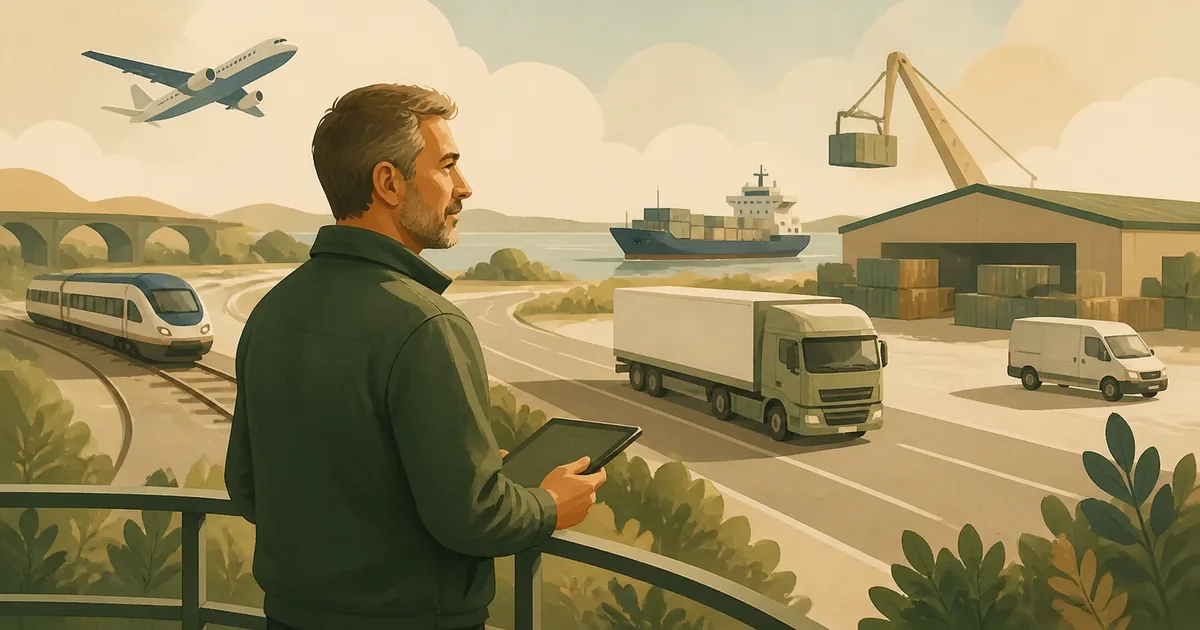
Denmark punches far above its weight in global transport and logistics. Home to Maersk (the world's largest container shipping company) and DSV (a top-3 global freight forwarder), the country is a natural hub for Scandinavian and European logistics. With Copenhagen Airport as the busiest hub in the Nordics, a dense motorway network, and strategic access to the Baltic Sea, transport and logistics careers in Denmark offer strong salaries, international exposure, and growing demand — especially as the green transition reshapes the industry.
For salary benchmarks across all industries, see our average salary guide. If you are considering a career in a specific trade, visit our trades careers guide.
Industry overview: Denmark as a logistics powerhouse
Transport and logistics accounts for approximately 6% of Danish GDP and employs over 130,000 workers directly. Denmark's strategic position between continental Europe and Scandinavia, combined with world-class infrastructure, makes it an ideal base for supply chain operations.
- Maritime: Denmark controls one of the world's largest merchant fleets. Maersk alone handles roughly 17% of global container shipping
- Road freight: Over 35,000 trucks registered in Denmark, with extensive cross-border operations to Germany, Sweden, and Norway
- Aviation: Copenhagen Airport (CPH) handles 30+ million passengers annually and is a major cargo hub
- Rail: DSB operates domestic passenger rail, while freight rail connects Denmark to the European network via the Great Belt Bridge and the Fehmarn Belt tunnel (opening soon)
- Warehousing and distribution: E-commerce growth has driven massive expansion in fulfilment centres around Copenhagen, Aarhus, and Kolding
Salary comparison: Transport and logistics roles
Salaries in Danish transport and logistics reflect the country's high cost of living and strong collective agreements. All figures are gross monthly salary in DKK, excluding pension contributions (typically 8-15% on top).
| Role | Entry level (DKK/month) | Experienced (DKK/month) | Senior/Manager (DKK/month) |
|---|---|---|---|
| Warehouse worker (lagermedarbejder) | 27,000-29,000 | 30,000-33,000 | 34,000-38,000 |
| Truck driver (lastbilchauffør) | 28,000-31,000 | 32,000-36,000 | 37,000-42,000 |
| Bus driver | 27,000-30,000 | 31,000-34,000 | 35,000-38,000 |
| Freight forwarder (speditør) | 30,000-34,000 | 35,000-42,000 | 43,000-52,000 |
| Shipping coordinator | 28,000-32,000 | 33,000-40,000 | 41,000-48,000 |
| Supply chain analyst | 33,000-37,000 | 38,000-45,000 | 46,000-55,000 |
| Logistics manager | 38,000-42,000 | 43,000-52,000 | 53,000-65,000 |
| Transport planner | 30,000-34,000 | 35,000-42,000 | 43,000-50,000 |
| Customs officer/specialist | 32,000-36,000 | 37,000-44,000 | 45,000-52,000 |
| Transport director | - | 55,000-65,000 | 65,000-80,000+ |
For broader salary context, see our complete salary guide. Truck drivers and warehouse workers often earn significant overtime and shift supplements.
Top employers in Danish transport and logistics
A.P. Moller-Maersk
The world's largest container shipping and logistics company, headquartered in Copenhagen. Maersk employs 100,000+ people globally and offers roles from vessel operations and terminal management to supply chain consulting and digital innovation. The company is investing heavily in green methanol-powered ships and end-to-end logistics services.
DSV
A top-3 global freight forwarder based in Hedehusene, Denmark. With 75,000+ employees across 90+ countries, DSV handles air, sea, and road freight as well as warehouse logistics. Known for rapid growth through acquisitions (Panalpina, Agility GIL) and a strong promote-from-within culture.
DFDS
Europe's largest integrated shipping and logistics company, operating a network of ferry routes connecting Denmark, the UK, Baltics, and Mediterranean. DFDS also has a significant road logistics division. Headquartered in Copenhagen with 14,000+ employees.
PostNord
The Nordic region's leading postal and parcel company, handling last-mile delivery, e-commerce logistics, and business mail. PostNord is a major employer in warehousing and distribution, with thousands of drivers and sorting centre workers across Denmark.
Other major employers
- SAS / Copenhagen Airports: Aviation roles from ground handling to cargo management
- DB Schenker: Global logistics provider with a strong Danish presence
- DHL Express / DHL Supply Chain: Express delivery and contract logistics
- Kuehne+Nagel: Swiss logistics giant with significant operations in Denmark
- Blue Water Shipping: Danish project logistics specialist based in Esbjerg
Education paths into transport and logistics
Denmark offers multiple entry points into the sector, from vocational training to university degrees.
Vocational training (erhvervsuddannelse)
- Lagermedarbejder: 2-year warehouse worker apprenticeship
- Lastbilchauffør: Truck driving qualification (requires category C licence + EU professional competence certificate)
- Speditør: 2-year freight forwarding apprenticeship combining classroom study and on-the-job training
Academy degrees (erhvervsakademiuddannelse)
- Logistikøkonom (AP degree): 2-year academy programme in logistics management (Cphbusiness, IBA Kolding, Zealand)
- Serviceøkonom: Service management with logistics specialization options
Bachelor's and master's degrees
- BSc/MSc in Supply Chain Management: Available at CBS, SDU, and AAU
- BSc in International Business: With logistics focus at CBS or SDU
- MSc in Operations Management: Technical University of Denmark (DTU)
For general guidance on education options, see our working in Denmark guide.
Applying for a logistics role in Denmark?
Our AI tool creates professional applications tailored to Danish employers. Stand out from the crowd.
Try free nowCertifications and licences
Several roles in transport require specific certifications.
- Category C/CE licence: Required for truck driving. Training takes 3-6 months and includes EU professional competence certification (kvalifikationsbevis)
- Category D licence: Required for bus driving
- ADR certificate: Required for transporting dangerous goods
- Forklift licence (gaffeltruckcertifikat): Required for most warehouse roles
- Customs broker certification: Valuable for freight forwarding and trade compliance roles
- APICS/SCOR certifications: International supply chain certifications valued at management level
Career progression
The transport and logistics sector offers clear career paths with good upward mobility.
- Warehouse worker → Team leader → Warehouse manager → Operations director: 5-15 years
- Speditør → Senior forwarder → Branch manager → Country manager: 5-12 years
- Graduate trainee → Supply chain analyst → Senior analyst → Head of supply chain: 5-10 years
- Truck driver → Fleet supervisor → Transport planner → Transport manager: 5-15 years
Many large companies (Maersk, DSV, DFDS) run graduate programmes that fast-track career development. International rotation is common, with opportunities to work in offices across Europe, Asia, and the Americas.
The green transition in transport
Denmark's ambition to reduce transport emissions by 70% by 2030 is reshaping the industry. This creates new job categories and shifts existing roles.
- Electric and alternative fuel vehicles: Maersk's methanol-powered container ships, electric delivery vans for last-mile, and hydrogen truck pilots
- Green logistics planning: Optimizing routes, consolidating shipments, and reducing empty runs to cut CO2
- Sustainability reporting: ESG compliance, carbon footprint tracking, and EU CSRD reporting requirements
- Rail freight revival: Shifting cargo from road to rail, boosted by the upcoming Fehmarn Belt tunnel connecting Denmark directly to Germany
- Cycling logistics: Cargo bike delivery is booming in Copenhagen and other Danish cities
Professionals with sustainability skills are increasingly sought after. See our green careers guide for more.
Working conditions and unions
Danish transport workers benefit from strong collective agreements and union representation.
- 3F Transport: The largest union for transport workers in Denmark, covering truck drivers, warehouse workers, bus drivers, and courier services
- Dansk Metal: Covers mechanics and technical staff in transport
- HK Handel: Covers office-based logistics workers, freight forwarders, and administrative staff
- Working hours: Standard 37-hour work week, though drivers and warehouse workers may work shifts (early morning, evening, night) with shift supplements
- Overtime: Regulated by collective agreements — typically 50% extra for the first 3 hours, 100% thereafter
- Pension: 8-15% employer contribution on top of salary, depending on agreement and seniority
International workers in Danish transport
The transport sector is one of Denmark's most international industries. Here is what you need to know.
- EU/EEA citizens: Can work freely. Many roles, especially at Maersk and DSV, operate in English
- Non-EU workers: Need a work permit. Several logistics roles are on the Danish Positive List for skilled workers
- Licence recognition: EU driving licences are valid in Denmark. Non-EU licences may need conversion — contact the local kommune
- Language: English is sufficient for many office roles at international companies. Danish is important for driving, warehouse, and customer-facing positions
For complete details on working in Denmark as an international, see our working in Denmark guide.
Frequently asked questions
What are the typical salaries in transport and logistics in Denmark?
Warehouse workers earn 27,000-33,000 DKK/month, truck drivers 30,000-38,000 DKK/month, freight forwarders 32,000-42,000 DKK/month, supply chain analysts 35,000-48,000 DKK/month, and logistics managers 42,000-55,000 DKK/month. Senior roles and directors can earn 55,000-80,000+ DKK/month.
Who are the biggest transport and logistics employers in Denmark?
Maersk (world's largest container shipping company), DSV (top-3 global freight forwarder), DFDS (Europe's largest ferry and logistics network), PostNord, SAS/Copenhagen Airports, DB Schenker, DHL, and Kuehne+Nagel.
What education do I need for a logistics career?
It depends on the role. Warehouse and driving roles need vocational training or licences. Freight forwarding requires a speditør apprenticeship or academy degree. Management roles typically require a bachelor's or master's in supply chain management or business.
How is the green transition affecting transport jobs?
Denmark aims to reduce transport emissions by 70% by 2030, creating demand for EV fleet managers, green logistics planners, sustainability coordinators, and data analysts. Maersk, DSV, and others are investing billions in green technologies.
Can international workers get transport jobs in Denmark?
Yes. EU/EEA citizens work freely. Non-EU workers need a work permit — several logistics roles are on the Positive List. English suffices for many office roles, but Danish is important for driving and warehouse positions.
Conclusion
Denmark's transport and logistics sector offers a remarkable range of career paths — from hands-on warehouse and driving roles to high-level supply chain management at some of the world's largest companies. With strong salaries, excellent working conditions, and a sector being reshaped by the green transition, there has never been a more dynamic time to build a career in Danish transport and logistics.
Whether you are starting with a forklift licence or a master's degree, the sector rewards both practical skills and strategic thinking — and Denmark's position as a global logistics hub means international opportunities are built into the career path.